

Table of Contents
ToggleArtificial intelligence is becoming an increasingly important part of performance marketing. Using ChatGPT to generate ad copy is one thing. Giving it access to real advertising data and testing how much it can actually support a Google Ads specialist in day-to-day work is quite another. At DITS.Agency, we decided to test the second scenario.
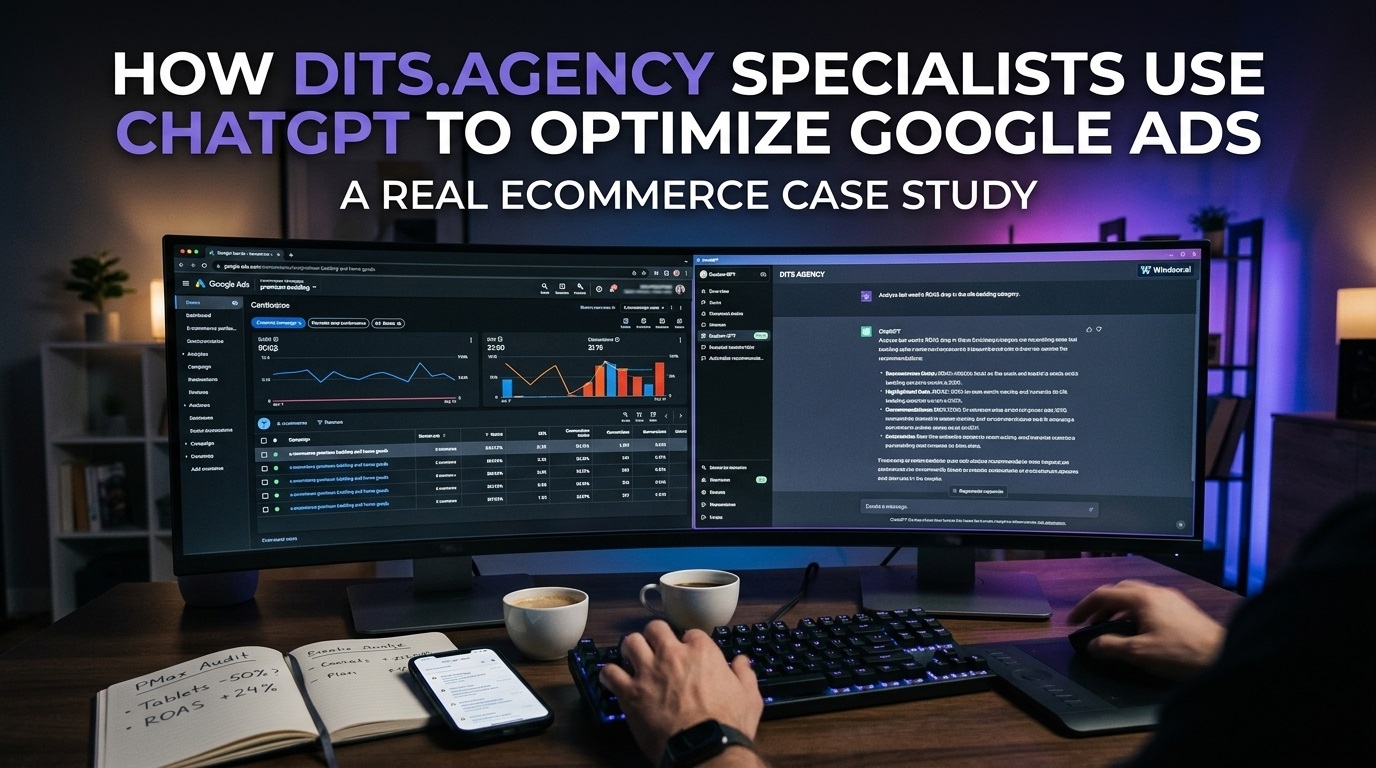
Our PPC specialist connected Google Ads to ChatGPT via the Google Ads by Windsor.ai connector and now uses it on a live ecommerce project: an online store selling premium bedding and home goods.
Our goal is to assess how much AI can speed up advertising data analysis, uncover additional growth opportunities, and strengthen the specialist’s work.
We are directly comparing two approaches:
- Traditional analysis performed by a Google Ads specialist.
- Specialist analysis supported by ChatGPT as an additional analytical layer.

Why We Decided to Test ChatGPT with Google Ads
In ecommerce, advertising accounts quickly accumulate huge volumes of data. A specialist has to monitor spend, conversions, CPA, ROAS, Performance Max and Search campaigns, search terms, product groups, devices, geographic performance, and seasonal fluctuations at the same time.
The challenge is not a lack of data, but how quickly it can be processed. A specialist needs to understand, as quickly as possible:
- Why did Cost per Purchase (CPA) increase?
- Which campaigns started using budget less efficiently?
- Which categories are growing, and which are generating less revenue or delivering a lower ROAS?
The first results of our experiment show that AI is particularly useful as an additional analytical layer, helping specialists identify deviations faster and formulate hypotheses more efficiently.
Why We Chose an Ecommerce Project
For the test, we selected an online store selling premium bedding and home goods. This type of project is well suited to the experiment because:
- It runs both Google Search and Performance Max campaigns.
- It includes several product categories with different performance patterns.
- Ecommerce conversions and revenue tracking are configured correctly.
- Performance is evaluated based on actual purchases, CPA, and ROAS rather than clicks alone.
The account also contains enough historical data for meaningful period-over-period comparisons. For us, it was essential to test AI not on a demo account, but on a live project where advertising decisions directly affect business revenue.
How the Integration Works
For the integration, we use Google Ads by Windsor.ai. It allows ChatGPT to access current data from the connected advertising account and analyze it directly within the conversation.
Our current workflow:
Google Ads → Windsor.ai → ChatGPT Analysis → Hypotheses → Specialist Review → Optimization → Follow-Up Analysis
We evaluate the quality and consistency of AI-assisted analysis: how accurately it compares periods, detects anomalies, identifies underperforming campaigns, and helps prioritize areas for deeper review.

What the Standard Workflow Looks Like Without AI
To evaluate ChatGPT objectively, it is useful to look at the standard process first. In a typical workflow, a DITS.Agency Google Ads specialist manually consolidates reports, compares period-over-period performance, analyzes search terms, reviews PMax segments, and evaluates product category performance.
Much of this work requires professional interpretation. At the same time, manually collecting and organizing data takes time that could otherwise be spent on strategic tasks.
What Changes After Connecting ChatGPT
Once the data connection is in place, the specialist can ask questions about the account in a conversational format:
- “Which campaigns saw the largest increase in CPA over the past week?”
- “Which product groups are spending budget without generating purchases?”
- “On which devices did ROAS decline the most compared with last month?”
- “What unusual changes appeared in search terms?”
Instead of manually compiling reports, the specialist can get a structured summary faster and move directly to reviewing the areas that require attention.
This shortens the path from data to problem to hypothesis: Data → Problem → Hypothesis.
What the Experiment Revealed: Real Observations from Our Specialist
We are documenting real situations from the advertising account: where AI helped, where its conclusions matched the specialist’s, and where its recommendations had to be rejected.
1. When ChatGPT and the Specialist Reached the Same Conclusion
- Situation: Overall ROAS in the “Silk Bedding Sets” category fell by 18% over the previous week, while the budget remained unchanged.
- What the specialist noticed: Spend in the Search campaign increased sharply on non-transactional informational queries such as “how to wash silk bedding” and “European bedding set sizes,” without generating purchases.
- What ChatGPT found: When asked to compare periods, the AI immediately identified the three campaigns with the largest ROAS decline and separately highlighted 12 search terms with the highest spend and zero conversions over the previous seven days.
- What we did: We added informational queries to the negative keyword list and redirected budget toward more transactional categories.
- Result: Within 10 days, category ROAS increased by 24%, while Cost per Purchase (CPA) decreased by 15%.
2. What ChatGPT Noticed That the Specialist Had Not Flagged
- Situation: A routine weekly performance review of Performance Max campaigns.
- AI observation: ChatGPT flagged an unusual 40% increase in CPA on tablet devices within the “Home Decor” PMax campaign, even though tablets accounted for only 6% of total traffic.
- Specialist review: The hypothesis was confirmed. Because of the site layout on tablets, the conversion rate was 2.5 times lower than on mobile and desktop, while the automated campaign continued acquiring this traffic.
- Action taken: Because device-level bid adjustments are not available in Performance Max, we assigned the UX team to optimize the cart experience on tablets and continued monitoring this segment separately.
- Result: We saved 8% of the weekly budget, and the campaign’s average CPA decreased by 9%.
3. When the Specialist Disagreed with ChatGPT
- AI recommendation: ChatGPT suggested reducing the budget for the branded Search campaign and the “Goose Down Duvets” category because their CPA had exceeded the target threshold by 35% over the previous 14 days.
- Why the specialist rejected it:
- Seasonality and margin: Goose down duvets have the highest average order value and margin, and demand begins to peak in early November.
- Inventory factor: Popular sizes (200×220) were temporarily out of stock, which reduced conversion rates. A restock was expected within two days.
- Branded traffic: Cutting branded activity could have meant losing high-intent customers to competitors.
- What we did instead: We kept the budgets unchanged, temporarily redirected traffic to alternative product categories, and added a pre-order notice. Once inventory was replenished, performance fully recovered.
4. Time Savings
We compared the time required for a complete rapid account review, including identifying performance drops and analyzing devices, categories, and search terms:
- Without AI: 60 minutes (manual analysis in the Google Ads interface and Google Sheets).
- With AI: 25 minutes (prompting, receiving a structured anomaly summary from ChatGPT, and selectively verifying the hypotheses).
Where Human Expertise Is Still Essential – and Why AI Can Be Wrong
Advertising metrics cannot be evaluated in isolation from the business context. A high CPA does not automatically mean a campaign should be scaled back. A category may have strong margins, be entering its peak season, play a strategic role, or temporarily convert poorly because of inventory or website issues. That is why an AI recommendation should be treated as a hypothesis that a specialist validates against real business conditions.
Why Accurate Tracking Becomes Critical
AI can only analyze the data it receives. If the underlying analytics are inaccurate, ChatGPT will also build its conclusions on an inaccurate foundation.
Before introducing AI into the analysis process, it is important to verify:
- Google Ads conversions and GA4 ecommerce tracking;
- Google Tag Manager setup, including the absence of duplicated purchase, add_to_cart, and begin_checkout events;
- correct transmission of value, currency, and revenue.
The quality of AI-assisted analysis depends directly on the accuracy of your tracking and analytics.
Will ChatGPT Replace a Google Ads Specialist?
No. ChatGPT does not replace a specialist, but it can significantly strengthen their work through AI-assisted analysis.
AI helps reduce routine analytical work, process large datasets faster, and identify anomalies more efficiently. This gives the PPC specialist more time to focus on strategy, budgeting, offer development, commercial context, and the effectiveness of advertising decisions.
FAQ: Windsor.ai Safety and Reliability
Is Windsor.ai Safe to Use?
Windsor.ai uses Google OAuth to connect to Google Ads, which means the service does not receive your Google password. For analytics purposes, Read-Only access is sufficient, and the connection can be revoked at any time through your Google Account settings.
From a data protection perspective, Windsor.ai states that it is SOC 2 Type II compliant, uses encryption for data in transit and at rest, and complies with EU GDPR requirements.
Is Windsor.ai a Legitimate and Reliable Service?
Yes. Windsor.ai is an established international SaaS data integration platform that has been operating since 2017. At the time of our review, it had a 4.4 out of 5 rating on G2. The platform supports Google Ads and other marketing data sources and can make that data available to ChatGPT and other analytics tools.
Can AI Be Fully Trusted to Manage Bids and Budgets?
We recommend an AI-assisted analysis model in which AI generates hypotheses, while a human specialist makes the final decision and implements changes in the account. Full autonomy through AI automation should only be considered after extensive testing, calibration, and validation of the system’s accuracy.
Want to Understand the Real Potential of Your Google Ads Account?
The DITS.Agency team provides comprehensive advertising account audits, configures GA4, GTM, and ecommerce tracking, and helps businesses implement modern AI tools for advertising analysis and optimization.