



What Is ROAS?
ROAS (Return on Ad Spend) measures how much revenue your advertising campaigns generate compared to the amount spent on advertising.
ROAS = Advertising Revenue / Advertising Spend
For example, if you spend $2,000 on Google Ads and generate $10,000 in attributed sales:
ROAS = $10,000 / $2,000 = 5
Your ROAS is 5x, or 500%.
However, this does not mean that your business has earned $8,000 in profit. You still need to account for the cost of products, shipping, payment processing, returns, and other expenses.
What Is CPA?
CPA (Cost Per Acquisition), when the acquisition event is a purchase, measures how much you spend on advertising to generate one order.
CPA = Advertising Spend / Number of Orders
If you spend $2,000 and receive 100 attributed orders, your CPA is $20.
Whether this is a good result depends on how much contribution margin each order generates.
What Is CAC?
CAC (Customer Acquisition Cost) measures the cost of acquiring a new customer.
Unlike purchase CPA, CAC focuses specifically on new customers and may include additional marketing and sales expenses beyond advertising spend.
For retailers with a high repeat purchase rate, customer lifetime value can also help determine an acceptable acquisition cost.
How to Calculate Your Break-Even ROAS
Break-even ROAS is the minimum advertising return required to cover the variable costs associated with your sales and advertising.
It is one of the most important metrics to calculate before launching Google Ads, Shopping, Performance Max, or Meta Ads campaigns.
Break-even ROAS = 1 / Contribution Margin Before Advertising
Your contribution margin should account for expenses such as:
Cost of goods sold (COGS).
Shipping and fulfillment costs.
Packaging.
Payment processing fees.
Marketplace or sales commissions.
Expected returns and other variable costs.
Revenue and costs should be calculated consistently, excluding recoverable VAT or sales taxes collected on behalf of tax authorities.
Break-Even ROAS by Contribution Margin
| Contribution margin before advertising | Break-even ROAS |
|---|---|
| 15% | 6.67x (667%) |
| 20% | 5.00x (500%) |
| 25% | 4.00x (400%) |
| 30% | 3.33x (333%) |
| 40% | 2.50x (250%) |
| 50% | 2.00x (200%) |
| 60% | 1.67x (167%) |
| 70% | 1.43x (143%) |
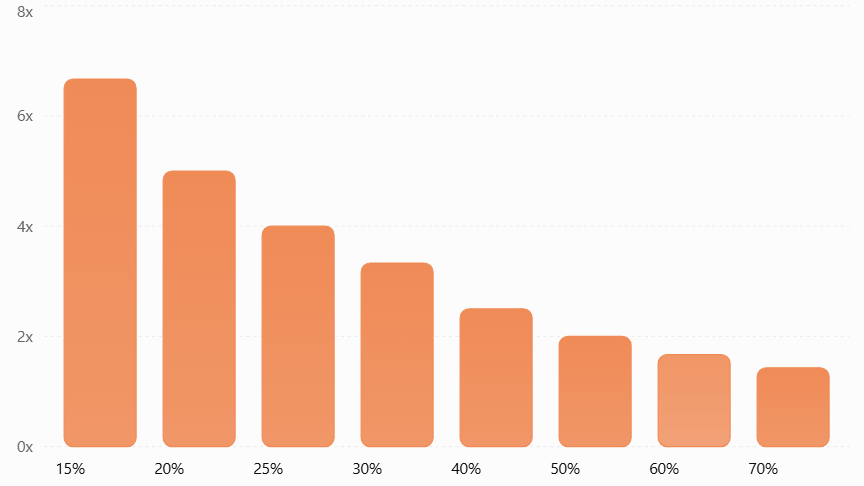
The lower your contribution margin, the higher the ROAS required to cover your advertising costs.
For example, a retailer with a 20% contribution margin needs a ROAS of at least 500% to cover variable costs and advertising. Meanwhile, a retailer with a 50% contribution margin needs only 200%.
Keep in mind that this calculation does not include fixed overhead or income taxes.
How to Calculate Your Target ROAS
Breaking even should not be the ultimate goal of your retail advertising strategy.
Your campaigns also need to generate enough contribution to cover fixed business expenses and support future growth.
To calculate your target ROAS, use the following formula:
Target ROAS = 1 / (Contribution Margin Before Advertising − Desired Margin After Advertising)
For example, imagine that your online store has a contribution margin of 40%, and you want to retain at least 15% after advertising expenses.
Metric | Value |
|---|---|
Contribution margin before advertising | 40% |
Desired margin after advertising | 15% |
Maximum advertising cost as a percentage of revenue | 25% |
Break-even ROAS | 2.5x |
Target ROAS | 4.0x |
Calculation:
1 / (0.40 − 0.15) = 4
This means that every dollar invested in advertising should generate at least $4 in attributed revenue to maintain your desired margin.
Your target ROAS is therefore 400%.
How Much Should a Retail Business Spend on Advertising?
One of the most common questions among online store owners is how much they should allocate to Google Ads or Meta Ads.
There is no universal advertising budget that works for every retailer. Your budget should depend on your product margins, revenue targets, customer acquisition costs, and growth objectives.
A simple way to estimate your advertising budget is to use the following formula:
Advertising Budget = Target Advertising Revenue / Target ROAS
For example:
Metric | Value |
|---|---|
Monthly revenue target from advertising | $50,000 |
Target ROAS | 4x |
Maximum advertising budget at the target margin | $12,500 |
Calculation:
$50,000 / 4 = $12,500
This provides a financial starting point for planning your advertising budget.
However, increasing advertising spend does not necessarily result in proportional revenue growth. Your ability to scale depends on market demand, competition, conversion rates, audience size, and campaign performance.
Why ROAS Alone Can Be Misleading
A high ROAS does not always mean that an advertising campaign is profitable.
Consider two different retail advertising campaigns.
Metric | Campaign A | Campaign B |
|---|---|---|
Revenue | $10,000 | $10,000 |
Advertising spend | $2,000 | $2,000 |
ROAS | 500% | 500% |
Contribution margin before ads | 50% | 15% |
Contribution before ads | $5,000 | $1,500 |
Contribution after ads | +$3,000 | −$500 |
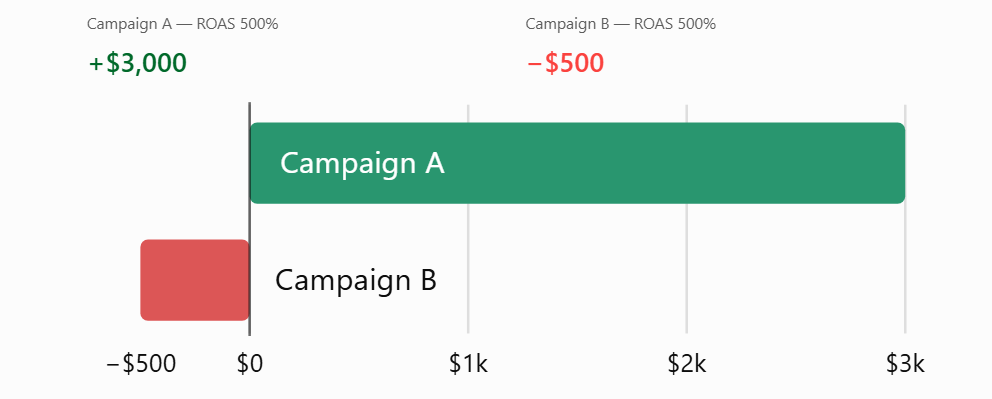
Both campaigns have exactly the same ROAS. However, one generates a positive contribution of $3,000, while the other loses $500 before fixed overhead.
This is why retailers should evaluate advertising performance based on actual business margins, rather than relying exclusively on the ROAS reported in Google Ads or Meta Ads.
Why You Should Calculate ROAS Separately for Product Categories
Most online stores sell products with different prices, costs, and profit margins.
For example, a retailer selling electronics and accessories may have significantly different contribution margins across these categories.
Consider this illustrative example:
Product category | Contribution margin | Break-even ROAS | Target ROAS for a 10% remaining margin |
|---|---|---|---|
Electronics | 15% | 667% | 2,000% |
Home appliances | 25% | 400% | 667% |
Clothing | 40% | 250% | 333% |
Accessories | 60% | 167% | 200% |
These margins are hypothetical and are not industry benchmarks.
Applying the same ROAS target across all product categories can lead to inefficient advertising budget allocation.
Low-margin products may generate high revenue without contributing much to business profitability. Meanwhile, high-margin products may remain profitable even with a lower ROAS.
When planning eCommerce advertising campaigns, consider grouping products according to their margins, sales performance, availability, and business priorities.
This approach can be particularly useful when structuring Google Shopping and Performance Max campaigns.
Common Mistakes When Calculating Retail Advertising Profitability
Ignoring Additional Business Expenses
Product cost is only one part of the equation. Shipping, payment fees, packaging, discounts, returns, and fulfillment costs can significantly affect advertising profitability.
Including VAT or Sales Tax in Revenue
When calculating profitability, use net sales revenue excluding VAT or sales tax collected on behalf of tax authorities. Otherwise, your advertising return may appear more attractive than it actually is.
Using the Same ROAS Target for Every Product
Different products have different margins. A single ROAS target may work for one category but generate losses in another.
Ignoring New and Returning Customers
Acquiring a new customer and generating another purchase from an existing customer are not the same thing.
Retailers with repeat purchases should also evaluate customer acquisition cost and customer lifetime value.
Relying Exclusively on Advertising Platform Data
Advertising platforms can attribute the same purchase to different channels. Attributed revenue also does not necessarily represent incremental revenue generated by advertising.
Compare advertising reports with your actual eCommerce sales data, analytics, and financial records.
How to Improve Advertising Profitability for an Online Store
Improving advertising profitability is not always about reducing your advertising budget.
Sometimes, the biggest opportunities are outside the advertising account itself.
Focus on improving product feeds, campaign structure, conversion tracking, website performance, product pages, average order value, and checkout experience.
It is also important to identify products and campaigns that generate revenue but contribute little to actual business profitability.
An effective eCommerce advertising strategy should connect marketing performance with the financial objectives of the business.
Need Help Running Profitable Advertising Campaigns for Your Online Store?
At DITS.agency, we help online stores and retail businesses launch, manage, and optimize paid advertising campaigns.
Our approach goes beyond clicks, conversions, and standard ROAS reports. We focus on understanding your business model, product margins, advertising costs, and growth objectives.
Our eCommerce advertising services include:
Google Ads management.
Google Shopping campaigns.
Performance Max campaigns.
Facebook and Instagram Ads.
Remarketing campaigns.
GA4 and conversion tracking.
Product feed optimization.
Advertising audits and campaign restructuring.
Advertising budget planning and performance optimization.
We work with online stores built on WooCommerce, Shopify, and other eCommerce platforms.
Whether you are launching advertising for the first time or looking to improve the profitability of your existing campaigns, our team can help you develop a data-driven advertising strategy tailored to your business.
Explore our Google Ads management services, Google Shopping advertising services, and paid social media advertising services.
You can also explore our client case studies to learn more about our experience in digital marketing, paid advertising, and eCommerce development.
Ready to improve your online store’s advertising performance?
Contact DITS.Agency to discuss your advertising strategy.
Frequently Asked Questions
What is a good ROAS for retail and eCommerce?
There is no universal good ROAS. The appropriate target depends on product margins, advertising costs, operational expenses, and your desired profitability. A ROAS of 300% may be sufficient for one online store but unprofitable for another.
What is the difference between break-even ROAS and target ROAS?
Break-even ROAS is the minimum advertising return needed to cover associated variable expenses and advertising costs. Target ROAS is the return required to retain a desired contribution margin after advertising.
Can a campaign with a ROAS of 500% lose money?
Yes. If the contribution margin before advertising is below 20%, a campaign with a ROAS of 500% will generate a negative contribution after advertising.
How do I calculate the maximum CPA for my online store?
Multiply your average order value by your contribution margin before advertising.
For example, if your average order value is $100 and your contribution margin is 40%, your break-even purchase CPA is $40.
To maintain a desired margin of 15%, your target purchase CPA would be $25.
How much should an eCommerce business spend on Google Ads?
Your advertising budget should be based on your revenue goals, contribution margins, target ROAS, and available market demand.
Use the calculator above to estimate how much your business can afford to spend.
Is ROAS the same as ROI?
No. ROAS measures advertising-attributed revenue relative to advertising spend. ROI measures the return on an investment relative to its cost and can account for a broader range of business expenses.
Should I include returning customers when calculating ROAS?
You can include attributed purchases from returning customers when calculating overall campaign ROAS. However, you should also measure new customer acquisition separately to understand how effectively advertising is expanding your customer base.
Conclusion
Calculating advertising profitability is essential for building a sustainable retail and eCommerce advertising strategy.
Instead of focusing exclusively on revenue and ROAS, retailers should understand their contribution margins, break-even points, customer acquisition costs, and actual financial results.
The goal of advertising is not simply to generate more sales. It is to generate sales that contribute to profitable and sustainable business growth.
Use our retail advertising profitability calculator to evaluate your campaigns, set realistic targets, and make better-informed advertising budget decisions.